
Paver Guides
Can You Lay Pavers on Dirt? Preparing the Ground in Slidell
Why pavers laid on bare dirt sink, how to prepare ground with a compacted stone base and sand bed, and when sand or concrete goes under pavers in Slidell.
Written by Big Easy Paver Patios
Key Takeaways
- You can set pavers straight on dirt, but they won’t stay level. Bare soil shifts, holds water, and lets pavers sink unevenly.
- A lasting paver surface sits on a layer of compacted crushed stone, a thin bed of sand, and a solid edge restraint.
- In Slidell, wet, low ground and a high water table make the base and the slope even more important.
- Sand over a compacted stone base is the standard method. Laying over existing concrete only works when the slab is sound and the height allows it.
- Planning a Slidell patio or path? Call Big Easy Paver Patios at (504) 688-4244.
Can I Just Lay Pavers on Dirt?
Quick Answer: You can, but it won’t last. Pavers laid on bare dirt sink and drift apart as the soil gets wet, dries, and settles, so within a season or two you’ll have dips, puddles, and trip edges.
That’s doubly true in Slidell, where much of the ground is low, soft, and slow to drain, and the water table sits close to the surface near the lake and the bayous. Soil like that can’t carry pavers by itself. What it can carry is a well-built base, and that base is the real answer to “how do you prepare ground for pavers.”
The rest of this guide covers what that preparation looks like step by step, and when sand or concrete belongs underneath.
Why Doesn’t Bare Soil Work Under Pavers?
Pavers are designed to work as one connected surface that sits on a firm, even layer. Dirt fails at both jobs:
- It isn’t uniform. One spot is firm and the next is loose fill or an old root, so pavers settle at different rates.
- It holds water. Wet soil softens under load, and every footstep presses pavers a little deeper.
- It has organic material. Topsoil and roots rot and compress over time, leaving voids.
- It lets weeds through. Grass and weeds grow up through joints from the soil right below.
When we get called to fix a patio that sank, a missing or thin base is the most common cause we find. Our post on why pavers sink and settle goes into the warning signs.
How Do You Prepare Ground for Pavers?
Here’s the sequence we follow on a typical patio or walkway in Slidell. The depths change with the soil and with what the surface will carry, but the order doesn’t:
- Call before digging. We contact Louisiana 811 at least 48 hours ahead, not counting weekends and holidays, so buried lines get marked.
- Lay out and plan the slope. The finished surface should fall away from the house so rain runs off instead of pooling.
- Excavate. We dig out the grass, topsoil, and soft material until we reach firmer ground.
- Compact the subgrade. The soil at the bottom of the dig gets compacted, and soft spots get dug out and replaced.
- Add fabric where the soil is weak. A geotextile layer keeps soft soil from mixing up into the stone.
- Build the base. Crushed stone goes down in layers, each one compacted. Industry guidance from the paver trade calls for at least 4 to 6 inches of compacted base under patios and walkways, and more under driveways or on soft soil.
- Screed the bedding sand. About 1 inch of coarse sand is leveled over the base. It’s a setting bed, not a structural layer.
- Set the pavers and edge restraint. Pavers go down in the pattern, the edges get locked, and the surface is compacted again before joint sand is swept in.

What Makes Ground Prep Different in Slidell?
Slidell sits on the east side of St. Tammany Parish, along the northeast shore of Lake Pontchartrain, and a lot of its neighborhoods are low and flood-prone. That shapes how we prep:
- Water first. If a yard holds water for days after a storm, we deal with the drainage before we talk about paver colors. See our drainage and grading in Slidell.
- Deeper base on soft ground. Wet, soft soil spreads the load poorly, so it gets more compacted stone and usually fabric.
- Careful with fill. Raising a low yard with fill can run into flood-zone rules, so check with the City of Slidell or St. Tammany Parish first. Our post on flood zones and fill rules explains why those rules exist.
- Plan for high water. A well-built paver surface can usually be checked and reset after a flood. Our guide to checking pavers after a storm or high water in Slidell walks through it.
Humidity and frequent summer storms keep Slidell soil wet for long stretches, so we’d rather overbuild a base than come back to reset a sunken corner.
Is It Best to Lay Pavers on Concrete or Sand?
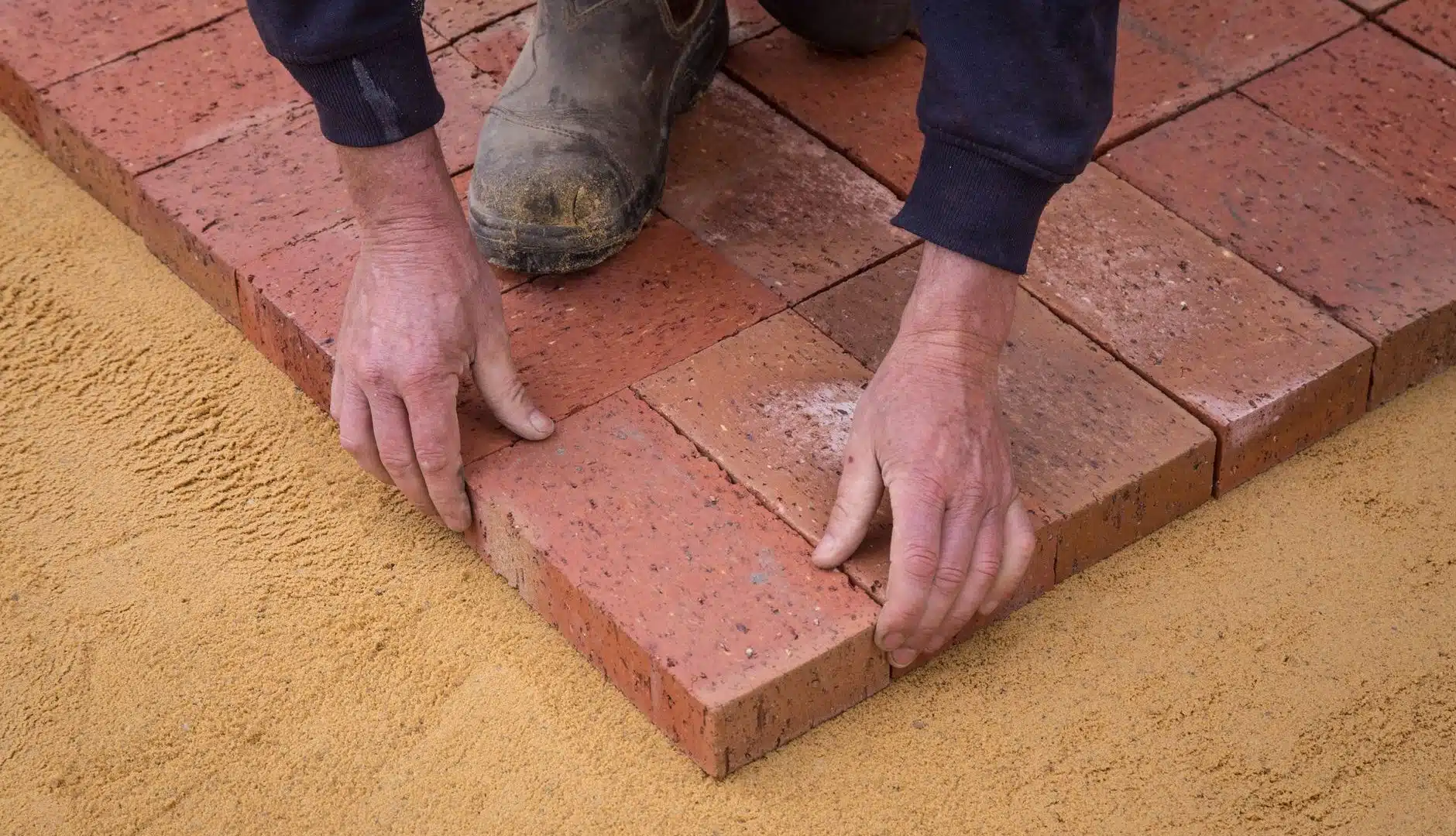
For a new patio or driveway, sand over a compacted crushed-stone base is the standard method and the one we use most. The sand bed lets each paver sit level, and the stone base below drains water and carries the load. The pavers can flex a little as the ground moves, and a low spot can be lifted and reset.
Laying pavers over an existing concrete slab is a different job. It can work when the slab is sound and drains properly, with enough height at doors and thresholds for the added thickness. It’s a poor choice when the slab is badly cracked or heaving, because those cracks will telegraph up through the pavers. Pavers can also be mortared to a slab, which makes a rigid surface that can’t be lifted and reset as easily.
We look at the slab before recommending either. In many Slidell yards, tearing out a broken slab and building a proper base costs less over time than covering a problem.
Which Pavers Work Best on Soft, Wet Ground?
The base matters more than the paver, but a few choices help on wet soil. Thicker units resist rocking under heavy loads. Textured surfaces grip better when wet, and lighter colors stay cooler in summer sun. Our guide to the best pavers for the Louisiana climate compares the options.
Polymeric joint sand also helps on a patio that sees a lot of rain, since it resists washout better than plain sand. Our post on keeping weeds out of paver joints covers how it’s used.
Frequently Asked Questions
Can I put pavers on dirt for a small garden path?
Stepping stones set into soil can work for a light-use garden path, but expect to reset them. A path you walk every day needs a base.
How deep should I dig for pavers?
Deep enough for the base and sand plus the paver thickness, with extra where the soil is soft. A driveway needs more than a patio.
Do I need landscape fabric under pavers?
On soft or wet soil, a geotextile under the base helps keep soil and stone from mixing. It isn’t a weed barrier for the joints.
Build Your Slidell Pavers on Solid Ground
We’ll check your soil and drainage, then give you a free written estimate that spells out the base we’ll build.
See our paver patios in Slidell or walkways in Slidell, start with the Slidell service area page, or call (504) 688-4244.
Keep reading
More from the blog

How Long Do Paver Patios Last in Abita Springs?
How long a paver patio lasts in Abita Springs, what wears out first under the pines, and the…
Read more
What Is the Cheapest Hardscape for a Kenner Yard?
The cheapest hardscapes ranked, from gravel to concrete pavers to natural stone, and why ground prep on soft…
Read more
How Much Does Hardscaping Cost in New Orleans?
What drives hardscaping cost in New Orleans, from demolition and base depth to drainage and access, and whether…
Read more